
Cardiovascular Diseases
Torsades de Pointes
It is a type of polymorphic ventricular tachycardia that is associated with prolonged QT interval (QT interval corrected for heart rate > 440 ms), whether acquired or congenital, unlike the polymorphic ventricular tachycardia that occurs in the acute phase of myocardial infarction, when the QT interval is not prolonged.

It is a type of polymorphic ventricular tachycardia that is associated with the prolongation of the QT interval (QT interval corrected for heart rate > 440 ms) which can be acquired or congenital, unlike the polymorphic ventricular tachycardia that occurs in the acute phase of myocardial infarction, when the QT interval is not prolonged. This differentiation is important because the tachycardia can be treated with medications that prolong the QT interval, such as procainamide, without risk for patients whose arrhythmia is not associated with a long QT interval, while they are contraindicated when this interval is prolonged during sinus rhythm.
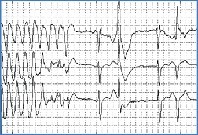
Electrocardiographically, it is characterized by the appearance of ventricular ectopic beats, mono or polymorphic, which cause episodes of pauses of variable duration, often interrupted by a normal beat (figure 1 A). The QT interval of this beat becomes prolonged due to the previous pause, predisposing to the occurrence of a new ventricular ectopic beat, which frequently occurs during the vulnerable period of the T wave. At this stage, the cardiac cells are in different stages of repolarization, some already completed, others still in progression. Such discrepancies predispose to fragmented ventricular activation and the subsequent onset of a polymorphic tachycardia characterized by QRS complexes with spikes oriented either upward or downward, as if they were spinning around their baseline (figure 1 B to D). The tachycardia is usually self-limiting (5 to 20 or 30 complexes), interrupting spontaneously, or degenerating into ventricular fibrillation. It is not yet determined what degree of QT prolongation is associated with the onset of ventricular tachycardia; however, values > 550 ms should be considered high risk, particularly in patients taking drugs that prolong this interval.
Torsades de Pointes Caused by Medications
One of the most important concepts acquired in recent years regarding antiarrhythmic therapy is that drugs indicated for the treatment of cardiac arrhythmias, whether ventricular or of supraventricular origin, can cause death, and the mechanism involved in this condition is torsades de pointes ventricular tachycardia. The most important predisposing factors for the triggering of this arrhythmia by antiarrhythmic agents are: long QT interval, ventricular dysfunction, myocardial ischemia, complex ventricular arrhythmias, bradycardia, electrolyte imbalance (particularly hypokalemia and hypomagnesemia), and a prior history of torsades de pointes. Women seem to be more vulnerable than men.
In addition to antiarrhythmics, other pharmacological agents are involved with torsades de pointes, including: a) psychotropics (phenothiazines, tricyclic antidepressants); b) antibiotics (erythromycin, sulfamethoxazole-trimethoprim, pentamidine); c) antihistamines (astemizole, terfenadine).
Torsades de Pointes and Congenital Long QT Syndrome
The Jervell and Lange-Nielsen syndromes, whose electrocardiographic alteration is associated with congenital deafness, are classically described; the Romano-Ward syndrome, not associated with deafness, and the idiopathic long QT syndrome, in which the QT is prolonged and there is a propensity for syncope and sudden death.
The pathophysiological mechanisms involved are not yet definitively clarified. One hypothesis is the discrepancy of autonomic ventricular innervation, with predominance of sympathetic activity over the left ventricle and hypoactivity on the right. It is on this theory that the concept of using beta-blockers and the surgical resection of the left stellate ganglion in treatment rests. Another theory is related to genetic anomalies, specifically located on chromosome 11, where mutations of genes related to coding proteins involved in the structure of channels that transport potassium currents (genes KVLQT1 and HERG for slow and fast potassium rectifier currents respectively) or sodium (SCN5A) prolong repolarization and consequently, the QT interval. Asymptomatic patients with unexpressed electrocardiographic alterations may present the arrhythmia when using drugs that prolong the QT interval.
Electrophysiological Mechanisms
Secondary early post-depolarizations to triggered activity would be responsible for torsades de pointes, both of congenital origin and acquired form. In this condition, before repolarization is complete, early oscillations of the action potential would reach the threshold potential, originating ventricular ectopies. Catecholamines and calcium currents make the cells more vulnerable. The arrhythmia could be maintained by this mechanism or, alternatively, through reentry secondary to the dispersion of ventricular repolarization.
Treatment
In the acquired form, the immediate suspension of the involved pharmacological agent is necessary. Additionally, potassium replacement when indicated and the administration of magnesium sulfate in a bolus (2 grams, followed by 2 to 4 grams 15 minutes later, if necessary, and continuous infusion of 3 to 30 mg/minute over the next 24/48 hours). The implantation of a temporary pacemaker for ventricular stimulation at rates between 90 and 110 beats per minute reduces episodes of tachycardia due to the reduction of the QT interval and the homogenization of ventricular repolarization. The administration of isoproterenol is indicated when there is no access to a temporary pacemaker. Prevention is done by avoiding the administration of drugs that cause prolongation of the QT interval.
In the congenital form, in patients with symptoms such as syncope or pre-syncope, the administration of beta-blockers is indicated. If symptoms persist, resection of the left stellate ganglion is associated. More refractory cases, when tachycardia becomes recurrent, or when there is a history of survived sudden death, even with the therapy already described, indication for implantation of an automatic implantable cardioverter-defibrillator exists.
The prognosis is good in those where symptoms are controlled with medications, becoming more reserved in patients with recurrent tachycardias, when the risk of death is higher.
The therapy is controversial in asymptomatic patients with long QT interval. Family history of syncope or sudden death are factors that increase the tendency for preventive treatment in these patients. There are no complementary tests with good predictive value to identify asymptomatic patients at higher risk of sudden death. Genetic studies may identify asymptomatic patients carrying chromosomal anomalies at risk of presenting the arrhythmia. However, these last studies are not being widely used yet, being reserved only for family members of affected individuals.
Figures – 24-hour Holter monitor of a 75-year-old patient, holder of atrial fibrillation on 600 mg of quinidine daily for maintenance of sinus rhythm.
Trace A shows sinus rhythm with ventricular ectopic beats and QT interval of up to 680 ms (measured in channel A). Traces B, C, and D are continuous showing the start and end of polymorphic ventricular tachycardia of the torsades de pointes type. Note the oscillation of the peaks of the QRS complexes around the baseline, typical of this type of arrhythmia. As occurs most of the time, these episodes are self-limited, interrupting spontaneously. In this case, the patient was hospitalized, the medication was suspended, and magnesium sulfate was administered, resulting in improvement of the clinical condition.
Figure A
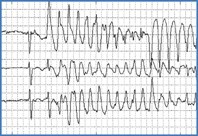
Figure B
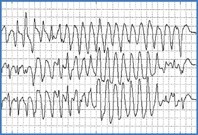
Figure C